


Press Enter to search

%20(1).jpg)
A blood draw that will not flash, an injection that stings more than it should, a needle that "felt dull" going in. When these reports reach a clinical educator or supply manager, the needle usually gets the blame. Often the real variable is the bevel: the angled, ground surface at the tip, how it was oriented, and what it touched before it reached the patient. This guide covers what the bevel does, when to orient it up or down, and what happens to a tip on the way in.
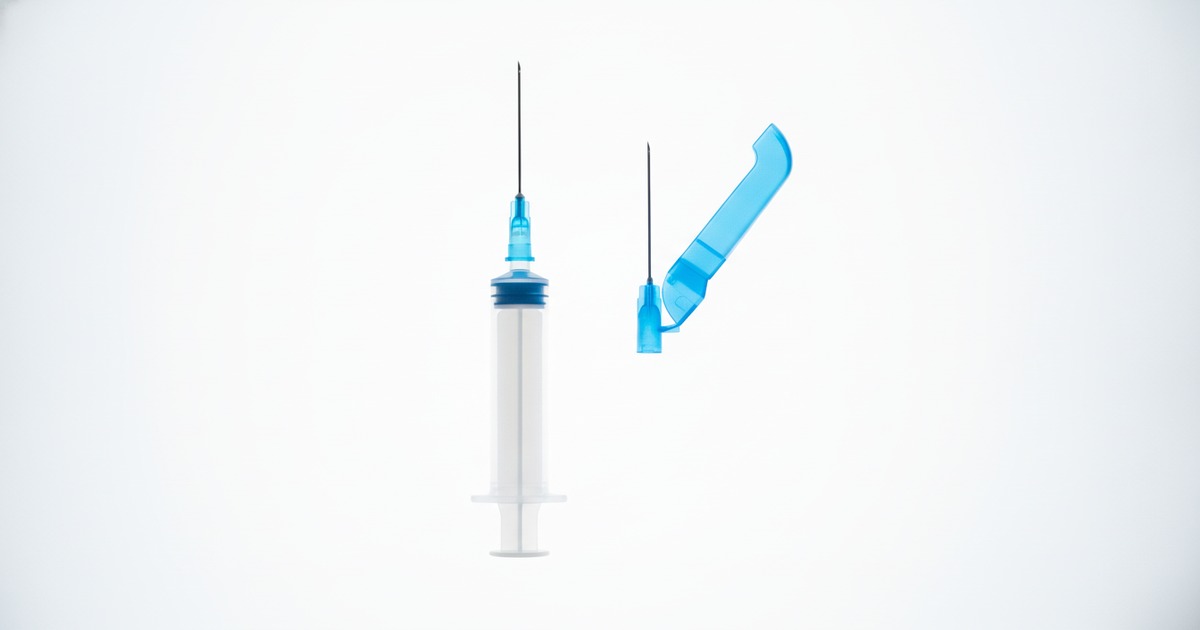
A hypodermic needle is a stainless steel tube ground at an angle so the opening sits on a slope rather than flat across the end. Our overview of the key components of a needle and syringe introduced the hub, shaft, and bevel. Most of what a clinician feels during insertion happens at the bevel.
The typical design is a three-facet point, sometimes called a lancet point. As a 2019 laboratory study of pen needle penetration force describes it, the primary bevel is ground at a set angle and two smaller side bevels are ground onto it to form the sharpest point. In that study, finer gauges and three-bevel tips needed less force to penetrate a test substrate than thicker gauges and five-bevel tips, and the authors noted lubrication as another factor that can reduce insertion force.
A regular bevel is longer and is generally described as entering tissue with less resistance. A short bevel has a steeper slope, intended to bring the whole opening past the vessel wall sooner in a shallow vein. The RELI® Conventional Hypodermic Needle has a siliconized three-facet bevel produced by computerized grinding with 100 percent visual camera inspection. It is available in regular and thin wall versions, with a short bevel option in 18G x 1.5 inch.
For venipuncture, the Clinical and Laboratory Standards Institute (CLSI) standard GP41 describes inserting the needle bevel up at an angle of 30 degrees or less. The idea is that the sharpest point leads and the opening faces away from the far wall, so the needle is less likely to score the vessel.
Orientation is measurable in comfort. In a randomized trial of subcutaneous lidocaine injection in 50 adult volunteers, pain scores were significantly higher with the bevel facing down than with the bevel facing up. In a separate study of intradermal injections, 98 participants each gave and received two injections. Those giving them found the bevel-up technique more comfortable and faster, while recipients reported no preference.
The RELI® Safety Hypodermic Needle is built so that when the safety shield is up, the bevel is up, which gives a quick visual reference for orientation.
Bevel up is a default, not a rule, and the evidence is not uniform.
A draw that starts and then stops is a familiar report. As the Center for Phlebotomy Education explains in its guidance on hidden causes of hemolysis, when the bevel is pressed against the vein wall, blood is forced through a partially blocked opening. The smaller the bore and the stronger the vacuum, the more violent that turbulence becomes. The result is a stalled draw or a hemolyzed sample, and the fix is usually technique, not a different lot of needles.
A needle that is sharp in the package can sustain tip deformation before it reaches the patient, and the damage may not be visible. A 2025 scanning electron microscopy study measured tip deformation on 30G to 32G needles used for facial injections. A control needle passed once through a rubber vial stopper showed 5.46 percent deformation. Mean deformation rose to 14.8 percent after three injection passes and 29.2 percent after ten, yet no deformation was visible on gross examination. Those were fine-gauge needles, so the figures do not transfer directly to larger hypodermic gauges.
In a study of 295 Quincke spinal needles used in routine spinal anesthesia, 4 percent of tips were clearly bent or hooked and 11 percent slightly bent. Bone contact was the main association: 7 percent of needles that touched bone showed clear tip damage, while 99 percent of those that did not were undamaged or only slightly bent. Under the microscope the clearly bent tips deviated 10 to 20 microns, a change too small to see.
Two habits are consistent with this evidence.
For cutting-tip neuraxial needles the answer is different: orient the bevel parallel to the long axis of the spine. In a randomized study of 1,558 women receiving epidural analgesia, 41 suffered an inadvertent dural puncture. Fourteen of 20 punctured with the bevel perpendicular to the dural fibers developed a moderate to severe headache, compared with 5 of 21 punctured with the bevel parallel. A meta-analysis of five randomized trials found post-dural puncture headache (PDPH) rates of 10.9 percent with parallel insertion versus 25.8 percent with perpendicular insertion.
Cutting spinal needles also depend on the fit between stylet and cannula. The RELI® Quincke Point Spinal Needle is ground so the stylet matches the cannula bevel exactly, designed to minimize coring and trauma, and is available in a short bevel version. Our review of spinal needle selection compares cutting and pencil point designs.
Before a complaint becomes a product complaint, ask four questions.
MYCO Medical supplies each of the devices above across its needles and syringes and Blood Collection product lines. If your teams are fielding these reports, contact our sales team to request evaluation samples in the gauges and bevel options that match your procedures.
What is the bevel of a needle?
The bevel is the angled, ground surface at the tip of a hollow needle. It forms the sharp point and the slanted opening through which fluid passes.
Why is the bevel up during venipuncture and injections?
With the bevel up, the sharpest point leads and the opening faces away from the far vessel wall, which is intended to help the needle enter smoothly. A bevel-up orientation also produced lower pain scores than a bevel-down orientation in a randomized subcutaneous injection trial.
When should the bevel face down?
A bevel-down orientation has performed better in specific procedures, including intradermal skin testing and ultrasound-guided radial artery cannulation. Follow the protocol your institution has adopted.
What is the difference between a regular bevel and a short bevel?
A regular bevel is longer and enters tissue with less resistance. A short bevel is steeper, so the whole opening clears the vessel wall sooner, which suits some anesthesia and vascular applications.
Does drawing up medication through the needle dull it?
In one fine-gauge needle study, a single pass through a rubber stopper produced measurable tip deformation under electron microscopy that was not visible to the naked eye. Drawing up with a blunt fill needle and injecting with a fresh needle helps keep the injecting bevel from ever contacting a stopper.
Why does a blood draw stop mid-collection?
A common cause is the bevel opening resting against the vein wall, which partially blocks flow and can hemolyze the sample. Reposition or rotate the needle slightly rather than increasing vacuum or plunger force.

.jpg)
%20(2).jpg)